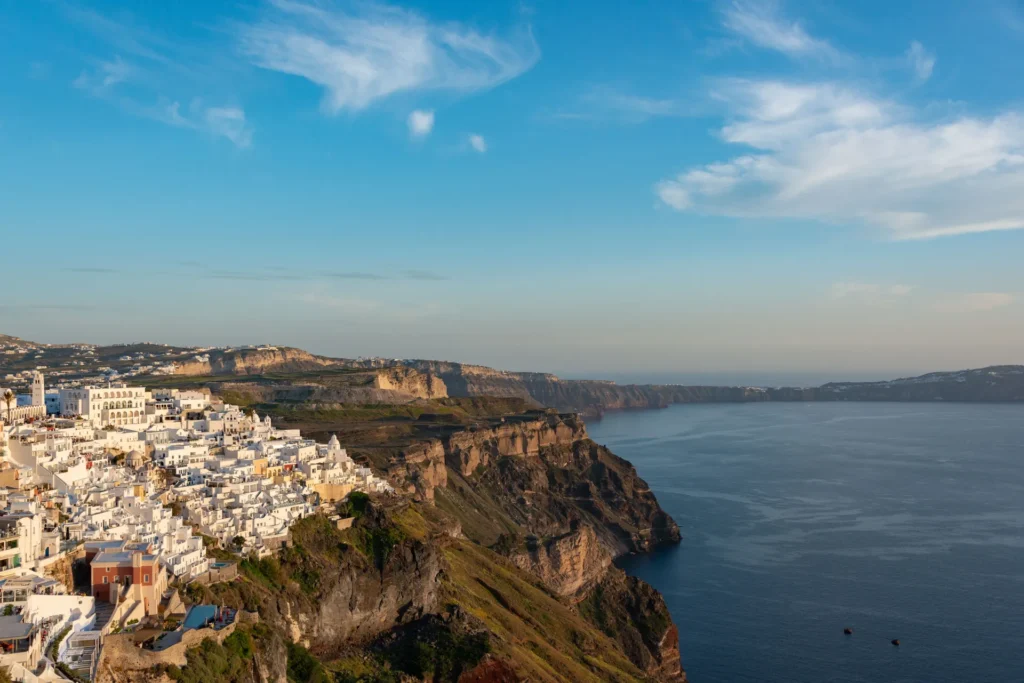
A honeymoon in Santorini is decided by one choice: which village you sleep in, because the caldera view, the crowd and the price all change village by village. The best months are May to early June and mid-September to early October. Four to five nights is enough, with Imerovigli the honeymoon pick for the view without Oia’s crowds.
Contents
- Which village decides the trip
- When to go
- Villages by couple type
- The sunset problem
- A 5-day plan
- Risks and practical
- FAQs
Which village decides the trip
Santorini is not one place. It is a crescent of villages on a cliff, and the village you sleep in decides the trip. The caldera view, the crowd and the price all change village by village, so the first decision is not the hotel or the flight, it is the village. Get the village right, and the rest of the trip falls into place. Get it wrong, and you pay the most for the least sleep.
The rule is simple: sleep on the caldera rim for the view, or sleep inland or on the east coast for the price and the quiet. There is no village that gives both, so the choice is the tradeoff. Our best honeymoon destinations guide is the full world list for 2027, and Santorini is the island on it that earns a guide of its own.
When to go
The best months are May to early June and mid-September to early October. May days run 21 to 25 degrees, warm enough to swim, everything open, crowds manageable, and the bougainvillea at its deepest pink. September brings the warmest sea of the year, 24 to 26 degrees by late September, crowds thinning after mid-September, and the grape harvest on the slopes. Late September into the first week of October is the connoisseur window: warm sea, long golden light, the August crush broken, and suite rates softening. October still works early in the month, though some smaller businesses start closing toward the end of October.
July and August are peak everything. It is hot, 35 degrees and more, three to five cruise ships anchor in the caldera on a typical peak day, the Oia sunset viewpoint is contested hours ahead, the streets gridlock, and caldera suites run EUR 400 to 800 a night. Go anyway if it is the only window, but say so plainly: July and August are the price of the calendar, not the best of the island.
April and October are the gamble: quieter and cheaper, but some businesses shut and ferries get cancelled in bad weather. Winter, November to March, is the quiet season: many hotels, restaurants and shops close, and the beach resorts at Kamari, Perissa and Perivolos mostly shut at the end of October. The caldera hotels in Fira and Oia stay open longest. The season runs roughly April to October.
Villages by couple type
Imerovigli is the honeymoon pick. It is the quietest caldera village, the highest point on the rim, with sunset views west and Skaros Rock in front, and the best boutique properties. It gives you Oia’s view without Oia’s prices and crowds. The tradeoff is real: few shops, no short walk to a beach, and about 2 miles, or 3 km, from Fira. Sleep here for the view without the Oia crowd.
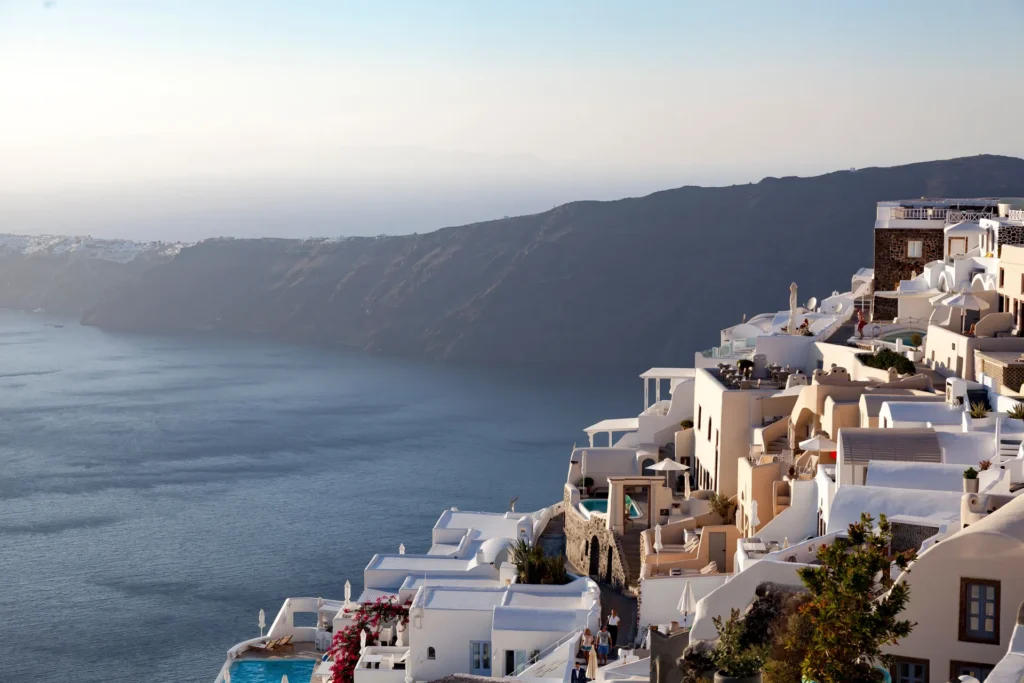
Oia is the postcard. It sits on the northern tip, blue domes and white lanes, with the sunset from your own terrace if you pay for it. It runs EUR 250 to 1,000-plus a night, the most expensive and most crowded village, and thousands pack the sunset viewing areas. Many hotels have no direct car access, so luggage is carried. Stay here only if the setting matters more than convenience. It is about 30 minutes by bus to Fira.
Firostefani sits just next to Fira, slightly quieter, with equally good caldera views. It is the middle ground for couples who want the view and the walk to Fira’s restaurants. Fira is the capital and the hub: the most restaurants, shops and nightlife, and the bus network radiates from here. It is the easiest base for first-timers, and the busiest at night, noisier than the rim villages.
Pyrgos and Megalochori are the quiet inland villages among the vineyards, with traditional tavernas and the island rather than the view. They are best for couples who want Santorini without the caldera premium. Kamari and Perissa, on the east coast, are the black-sand beaches: flatter, cheaper, easier with a car, with beachfront dining and no caldera view. They are best for the beach half of the trip, not the whole honeymoon. Akrotiri is the history base, near the archaeological site and Red Beach.
The sunset problem
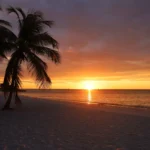
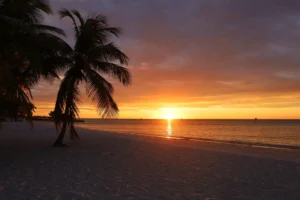
The sunset is the problem, because everyone wants the same one at the same time. Oia’s castle viewpoint fills hours ahead in July and August, and the view is partly blocked by raised phones. So do not make the castle viewpoint your default plan. The fix, in order, is to watch from your own caldera terrace, book a reserved caldera restaurant, take a sunset catamaran, or watch from Imerovigli.
Cruise days make it worse: on heavy cruise days Fira and Oia are packed from late morning to late afternoon. Check the cruise schedule, explore early, then go to a beach or a winery at midday. The island is yours in the morning and the evening; the middle of the day belongs to the ships.
A 5-day plan
Here is the shape that works for five nights. Day one is arrival: settle in Imerovigli, and watch the sunset from your own terrace. Day two is the rim: walk Imerovigli to Fira in the morning, and take a wine tasting at Santo Wines at sunset, the calmer alternative to the Oia crush. Day three is the sea: a catamaran cruise to the volcanic islands and the hot springs, the one boat trip worth the money. Book ahead in July and August; it is bookable later in shoulder season.
Day four is the walk: the Fira to Oia caldera walk, started early, never after 8 AM in summer heat, with water carried. Oia in the evening, after the crowds thin, is the best of Oia. Day five is slow: a morning in Pyrgos or Megalochori, or a half-day at Akrotiri and Red Beach, and then the departure. Our Europe guide covers the continent in full, and the plan above is the Santorini trip itself.
Risks and practical
ATVs and scooters are the single biggest hazard on the island. The roads are narrow and steep, with no guardrails, and tourists are seriously hurt every summer. Skip the ATV rental, take the bus or a small car. The caldera cliff paths, steep stairs, unfenced drops and low walls in Fira, Firostefani, Imerovigli and Oia, around Skaros Rock, on the steps to Ammoudi Bay and the Fira Old Port, are the same kind of risk: loose gravel, steep steps, serious drops.
Summer heat runs 35 degrees in July and August, amplified by reflection off the white buildings. Taxis are limited, especially at the port and in high season, so pre-book transfers for arrival and departure days. The beaches are volcanic black or red sand and pebbles, not white sand, so do not come to Santorini for a beach honeymoon: the beach towns are the second half, not the point.
The US State Department rates Greece Level 1, exercise normal precautions, with the advisory last updated 23 October 2025, and no separate rating for Santorini. The emergency number is 112. The early-2025 earthquake swarm is history, and the island is open and operating normally. The average honeymoon costs about $5,500 per couple for roughly 7 days, and 69 percent of couples take one, according to The Knot 2026 Real Weddings Study. Book 6 to 9 months out for peak-season rooms, and caldera suites need 3 to 6 months ahead at minimum, 4 to 8 months for July and August. Our Italy guide covers the other classic honeymoon, and the two trips are very different.
FAQs
May to early June and mid-September to early October. May days run 21 to 25 degrees with everything open and manageable crowds. September has the warmest sea of the year, 24 to 26 degrees, and the crowds thin after mid-September. July and August are the hottest, most crowded and most expensive months.
Imerovigli is the honeymoon pick: the quietest caldera village, the highest point on the rim, with sunset views and Skaros Rock in front, and Oia’s view without Oia’s prices and crowds. Oia is the postcard, and the most expensive and most crowded. Fira is the hub, and the easiest base for first-timers.
Four to five nights is enough. One base is the right call: the island is small, and moving between villages wastes the trip. Five nights gives you the rim, the catamaran, the walk and a slow day.
It is one of the most expensive Greek islands. Oia runs EUR 250 to 1,000-plus a night, and caldera suites run EUR 400 to 800 a night in July and August, 40 to 50 percent lower in May and early June. Shoulder-season rooms commonly run 30 to 50 percent below the July-August peak at the same property. A caldera-view room costs several times what an identical room without the view costs a few hundred yards back.
No, not as a beach honeymoon. The beaches are volcanic black or red sand and pebbles, not white sand. The beach towns, Kamari and Perissa, are the second half of the trip, not the point. Santorini is a caldera honeymoon: views, sunsets and villages.
No, and they are the single biggest hazard on the island. The roads are narrow and steep, with no guardrails, and tourists are seriously hurt every summer. Skip the ATV rental, take the bus or a small car.
Santorini is safe for most couples, with the usual care: steep stairs and unfenced drops on the caldera rim, loose gravel on the cliff paths, and summer heat amplified by the white buildings. The US State Department rates Greece Level 1, exercise normal precautions. The emergency number is 112.
This guide is for planning only and is not travel advice. Check entry requirements before a 2027 trip to Greece or Italy, and check the CDC destination page before booking international travel.