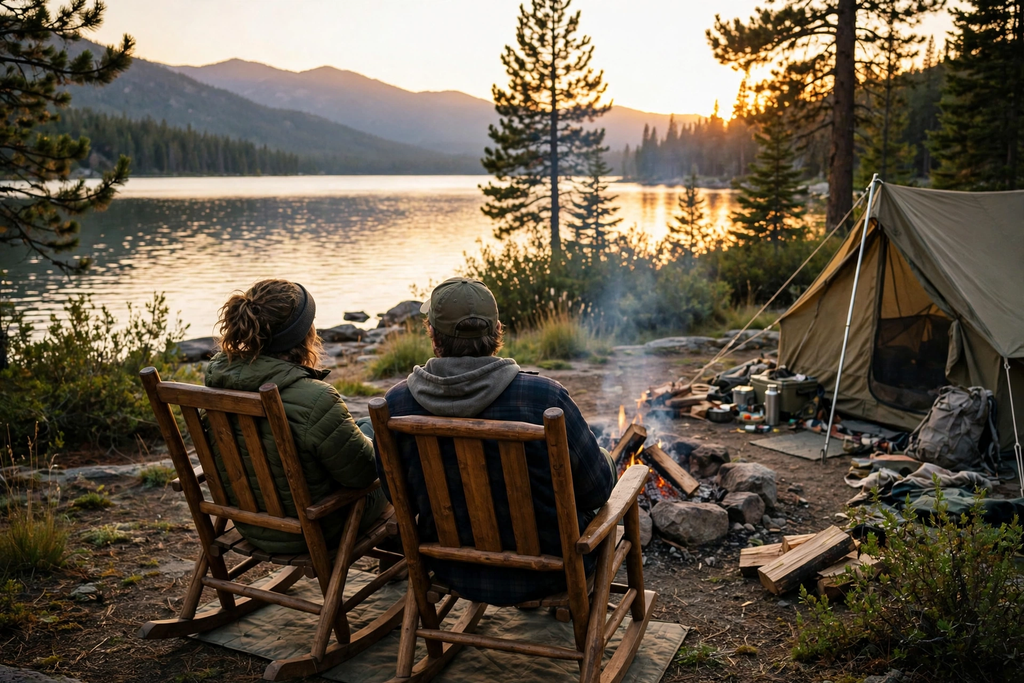
The chair is the destination. What a rocking camp chair does to an evening for two.
Nobody hurries in a rocking chair. That’s the whole technology. On a slow trip, the evening isn’t a gap between activities. It is the activity. And the difference between a chair you perch on and a chair you settle into is the difference between watching the light change and checking your phone while it does. It is the quiet flaw in almost every slow trip for two: you book the campground for lingering, or the cabin with the porch, or the beach rental for the long evenings, and then discover there is nowhere comfortable to actually sit and unwind together for hours. A picnic bench bolted down facing the wrong way. A cooler doing duty as a seat. Two camp chairs so low and flimsy that after twenty minutes you’d rather stand. The trip was planned for togetherness, and the seating never got the memo. My wife and I have planned trips around viewpoints, around restaurants, around one perfect beach. These days we plan them around something smaller. Wherever we land, the first decision we make at a site is where the chairs go. Everything else, the tent, the kitchen box, the fire, arranges itself around that spot, because that spot is where the trip will actually happen.
Where a Camping Day Is Really Spent
Think about how a camping day is really spent. The drive is a few hours. A walk, a swim, a wander into town, a few more. But the long, golden stretches, the early coffee and the late light, are spent sitting. Most people plan everything except that. The route gets researched, the tent gets upgraded, the meals get planned down to the seasoning, and then the seating is whatever folding chair was leaning by the garage door, grabbed on the way out. It’s an afterthought with a four-legged wobble, and it quietly shapes the whole trip. A chair you can’t settle into keeps you half-standing all evening. You perch, you shift, your back complains, and without ever deciding to, you drift: to your phone, to bed early, to the feeling that the day is somehow already over. The place didn’t hurry you. The chair did.
Why Rocking Changes the Evening
A rocking chair refuses all of that. Rocking is the oldest slow technology there is, older than the porch it usually sits on, and it works on the body before it works on the mind. The rhythm gives your hands and eyes permission to do nothing. Conversation changes in a rocking chair. It loosens, it wanders, it takes the long way, the same way a good walk does. Nobody has ever rocked quickly through a sunset to get it over with. For couples especially, two chairs rocking at slightly different tempos is its own kind of companionship: together, unhurried, facing the same view, saying plenty or nothing at all.
Start With the Frame: What Makes a Chair Rock Well
If you’re choosing one, start with what makes a chair rock well, because not every curve is equal once you leave the porch. The frame is where a rocking chair either earns its keep or doesn’t. Long, gently curved rails give a slow, deep rock; short, tight curves give a nervous little nod. On grass, wide rails are your friend: they spread your weight instead of sinking a narrow edge into soft ground. On gravel, a rocker is forgiving, because the rails bridge the stones instead of finding every one of them the way four chair legs do. Sand is the honest test: look for broad, flatter rails, and set the chair on the firmest patch you can find, just above the tide line or at the edge of the site where the ground is packed. A decent guide to camping rocking chairs will walk you through the frame designs and rail shapes far better than a product listing will, and it’s worth ten minutes before you buy, because the frame decides whether the rock feels like a porch or a seesaw.
Seat Height: Comfort That Has to Last All Evening
Seat height matters more than it sounds, especially across a whole evening. Too low and every refill of a coffee cup becomes a small negotiation with your knees; too high and your feet never quite rest. For long, slow sits, look for a seat that lets your feet sit flat and your legs stretch out in front of you, with armrests at the height where a book or a warm mug can rest without your shoulders creeping up. A slight recline helps more than padding does. The chairs we’ve kept over the years aren’t the softest ones. They’re the ones shaped so that an hour passes and you realise you haven’t shifted once.
Fabric, and Thinking of Two Chairs as a Pair
Fabric is the quiet half of comfort. On warm evenings, a breathable weave keeps a long sit pleasant where a solid, sweaty panel won’t. When the air cools, that same chair with a blanket over the back is all the lounge most campsites ever need. If you camp anywhere with dew (and everywhere has dew), a fabric that dries by the time the coffee’s made earns its place, because nobody lingers in a damp chair. And think about the pair of chairs as a set, not two singles. Angle them toward each other as much as toward the view, close enough that a small shared table fits between: two mugs, one book being passed back and forth, a lantern as the light goes. There are two-person chairs, and they’re sweet, but most couples we know end up preferring two singles. You each get your own rock, your own rhythm, and you can turn one chair toward the sunset and one toward the fire as the evening changes its mind.
Place the Chairs for the Hour You Care About
Then there is the shade, which is really a scheduling problem. A chair placed for the morning will betray you by four o’clock, so slow campers learn to place for the hour they care about most. Ours is the evening. When we arrive, one of us walks the site and works out where the shade line will fall at six, not where it sits at noon, and the chairs go on the cool edge of it, close enough to feel the day’s last warmth without sitting in it. In the morning, the same chairs migrate a few steps into the first sun for coffee, and that small twice-daily move becomes the rhythm of the day: chairs up with the sun, chairs settled before the light goes. It takes two minutes and saves the whole evening. If a site has no natural shade, a simple tarp strung between two trees, or even the vehicle’s awning, makes a room out of open ground, and a rocking chair under it, with a book and nowhere to be, is about as luxurious as travel gets.
The Chair Becomes the Day’s Punctuation
Used this way, a chair stops being furniture and becomes the day’s punctuation. It is where the morning starts before any plan does, where the middle of the day pools during the hot hours, and where the evening ends long after dinner. It is also, not incidentally, where the best conversations of a trip tend to happen: the unplanned ones, after the fire is lit and nobody is performing the day anymore. Trips measured that way don’t need much filling. A short walk feels like an outing when you know the chairs are waiting, and a whole afternoon can pass in the shade without anyone calling it wasted, because sitting there was the point all along.
Check the Packed Size Before You Buy
The last thing to check is the packed size, because a rocking chair has to justify itself in a car boot next to everything else. Modern camping rockers fold flatter than you’d expect, and ours rides on top of the load, first thing out when we arrive. That ordering isn’t an accident. It earns its space because it’s the most-used thing we bring, more than the stove, more than the good pan. Nobody ever sat by a lake at golden hour and wished they’d packed a slightly better tent peg. They wish they’d brought a chair worth sitting in.
The Destination Was the Chair All Along
So this is the whole secret, and it isn’t really about chairs. A slow trip is built out of places to linger, and the humblest of them is a chair facing the right way at the right hour. Pick the spot where the light lands last. Set two chairs on it. Let the evening take as long as it takes. The destination was never the viewpoint on the itinerary. It was the chair, and the person rocking beside you, and nowhere else to be.
Author
By Brian Ka of Tent Camping Pro