

Introduction
“Fairytale” gets tossed around a lot when people talk about travel destinations. Few places actually earn it the way Gruyères, Switzerland does, with a serenity and storybook whimsy that’s hard to fake. Plenty of travelers pass through Switzerland and skip this little town entirely, and honestly, that’s part of the appeal. It hasn’t been spoiled by the masses yet.
One glimpse of sweeping blue skies over Gruyères Castle, the scenic rolling green hills stretching as far as the eye can see, and a cobblestone town square that looks like an untouched relic from the Middle Ages, and it’s easy to hope it stays that way.
Beyond the postcard views, though, this guide covers the practical side too, getting there, what things actually cost, and how much time to set aside. The quick facts below cover the essentials before diving into everything Gruyères has to offer.
Gruyères at a Glance
| Category | Details |
| Region | Fribourg canton, Switzerland |
| Known For | Medieval castle, Gruyère cheese, H.R. Giger Museum |
| Location | Halfway between Montreux and Bern, near Fribourg |
| Getting There | Train via Bulle (2+ hours from major cities), or by car via the A12 motorway |
| Best Time to Visit | Good year-round; winter stays mild (1–8°C Dec–Feb) |
| Ideal Trip Length | 1 full day for highlights, 2 days with Mount Moléson or Broc |
| Getting Around | Walkable village; buses connect Gruyères, Bulle, Moléson, and Broc |
| Local Perk | Free entry to castle, museums, and Cailler factory with the Swiss Travel Pass |
| Currency | Swiss Franc (CHF) |
| Nearby Highlights | Mount Moléson (2,002m), Cailler Chocolate Factory (Broc), Bulle |
Why Visit Gruyères?
A stroll through this car-free town turns up one photo motif after another. Cobblestones lead past a beautiful fountain, flanked by historic buildings that haven’t changed much in centuries. No matter where you stand in Gruyères, the view stretches out over green hills into the Fribourg Pre-Alps, and that view alone makes the trip worthwhile.
The History Behind Gruyères
The name Gruyères traces back to legend. Gruerius, the town’s founder, once captured a crane, “grue” in French, and adopted it as his heraldic animal. Town records first mention it around 1138-39, referred to as “de Grueri,” though much about the House of Gruyères’ early years remains mysterious.
The settlement grew up beneath the castle, which the Count of Gruyère built atop the hill to control the upper Saanen valley. By 1195-96, it had become an official market town with a central street and its own city walls, developing separately from the castle above it.
On 22 June 1476, Gruyères joined the Battle of Morat against Charles the Bold, Duke of Burgundy. Alongside the Old Swiss Confederacy, the town helped rout the Burgundian army and even captured pieces of the Order of the Golden Fleece. Ownership of the castle shifted hands repeatedly over the centuries. Nineteen counts held it between the 11th and 16th centuries, the last, Michel, ending in bankruptcy by 1554. Bailiffs and prefects from Fribourg took over from 1555 to 1798.
By 1849, the castle went up for sale and was bought by the Bovy and Balland families, who restored it with help from painter friends. The canton of Fribourg bought it back in 1938, turning it into the museum still open to visitors today.
Where Is Gruyères & How to Get There?
Gruyères sits roughly halfway between Montreux and Bern, Switzerland’s capital. Along the way, a stop in Fribourg, the canton that gives Gruyères its name, adds only half an hour to the trip by car. The town holds a genuinely privileged position, perched atop a hill overlooking the Fribourg Prealps. That fairy-tale silhouette appearing as you climb toward it makes the arrival almost as good as the visit itself.
Driving in works well, and paid parking sits in lots just below the medieval village, followed by a short uphill walk. The A12 toll motorway is the most common route, though a vignette, an annual toll sticker bought at gas stations for around 40 francs, is required for driving on Swiss motorways.
Trains cover the route too, from major cities like Geneva, Bern, or Zurich, connecting through Bulle before a local train continues on to Gruyères. Expect at least two hours for the full journey, and trains here don’t run as frequently as you might hope.
Planning a longer trip? Our 5-day Switzerland itinerary covers how to fit stops like this into a bigger route.
Best Time to Visit Gruyères
Unlike other Swiss destinations, Gruyères skips the extreme cold that hits harder elsewhere in winter. That makes it just a good place to visit any time of year, without waiting for a specific season.
Even at the coldest stretch, between December and February, temperatures stay mild by Swiss standards, hovering around 1 to 2°C at night and climbing to 6 to 8°C during the day.
Timing matters everywhere you travel our seasonal travel guides break down when to go for other destinations too.
How Much Time Do You Need in Gruyères?
Gruyères was made for day trips. This small town even turns sleepy by mid-afternoon, especially after a few cocktails at the town’s alien-themed bar. Give yourself more time if hiking is the plan, since mountains surround the area on every side. A less pricey base nearby also opens up room for outdoor adventure.
For most visitors, though, a full day here works just fine, and it’s still a lot of fun.
Exploring the Medieval Village
Cobblestone Streets & the Old Town Fountain
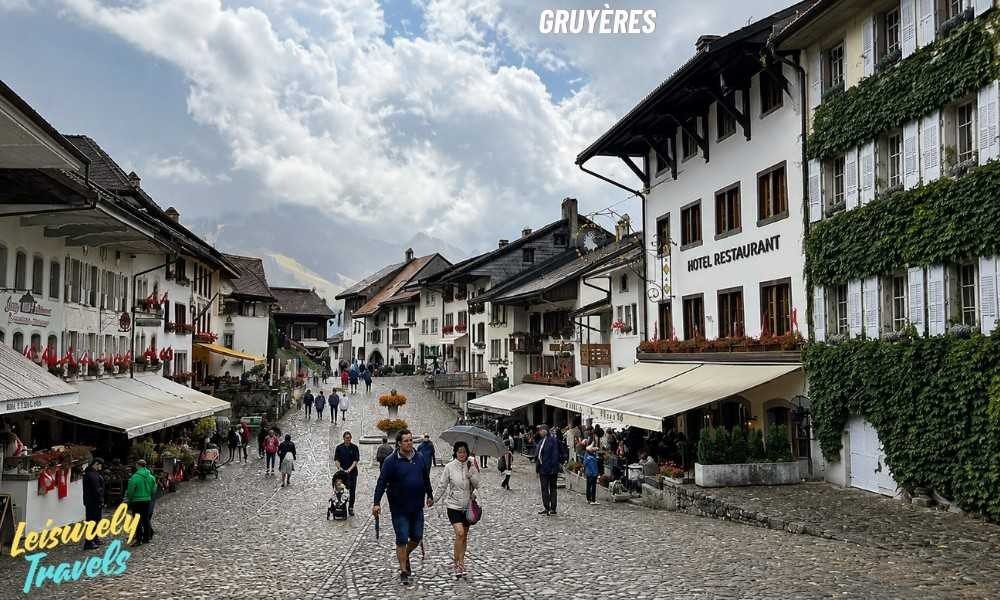
A stroll through this car-free town turns up one photo motif after another. Cobblestones lead past a beautiful fountain, flanked by historic buildings that haven’t changed much in centuries.
Rue du Bourg
Along Rue du Bourg, the town’s main street, several houses carry real historical weight, including the properties at numbers 7, 39, and the house dite de Chalamala at number 47. These, along with the town’s fortifications and the wider village itself, sit listed among Switzerland’s heritage sites of national significance.
Château de Gruyères
Downloading the Château de Gruyères app before arriving is worth the two minutes it takes. It’s free, and it provides narration for a self-guided tour once inside. The interior is beautiful on its own, but the exterior deserves just as much attention, especially the perfect French-style garden, a reminder that this corner of Switzerland speaks French.
Views of that garden from one of the balconies are properly incredible and honestly worth pausing for longer than planned. Inside, the castle holds rooms full of period furniture and exhibits tracing life back to the 13th century.
The real draw, though, is the view, from the landscaped gardens to the panoramic terraces, especially on a quieter day when the crowds thin out. No advance tickets are needed here, either. Show up, buy one at the door, or use a combo ticket picked up earlier that day, and exploring it self-guided works just as well as joining a tour.
Prices run reasonably: adults pay 13 CHF and children 5 CHF. Swiss Travel Pass holders enter for free. A family pass for two adults and up to three children comes to 29 francs, and combined tickets pair the castle with the H.R. Giger Museum, the Tibet Museum, or Maison Gruyères.
Current hours and any special exhibitions are worth checking on the official Château de Gruyères site before visiting.
Église Saint-Théodule
Views of this church open up from above while exploring the castle grounds. The Église Saint-Théodule de Gruyères is a 13th-century Gothic church dedicated to Saint Theodul, the patron saint of the region. Stepping inside reveals stained glass windows and an impressive organ worth a quiet moment. Admiring it from the outside works just as well, set against the pastoral landscape that surrounds it.
A small cemetery sits right next to the church, adding to the scene worth photographing. Taking the short walk over is worth it too, since it pulls you away from the busier, more touristy stretch of Gruyères and into a quieter corner of the interior.
The H.R. Giger Museum & Bar
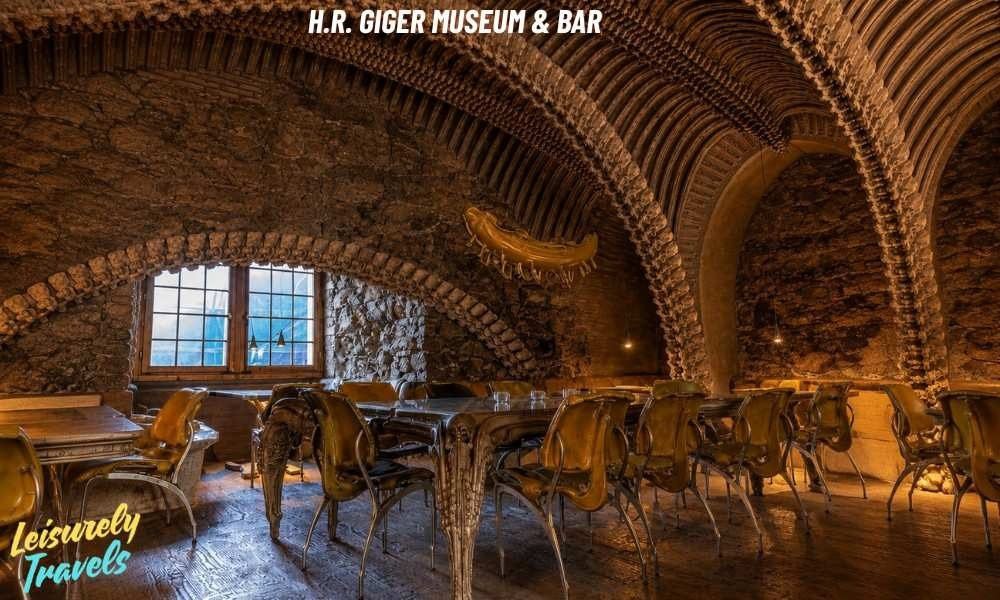
Back in 1998, the Swiss artist H.R. Giger, known for his surrealist paintings, sculptures, and film set designs, bought Saint-Germain Castle and transformed it into a lasting showcase dedicated entirely to his own creations. This might rank as the strangest museum around, and it’s worth skipping if traveling with kids since the content isn’t exactly appropriate for them. Otherwise, an hour or so spent inside this 400-year-old château makes for a genuine tribute to Giger’s work.
Giger built his reputation designing the creatures for Alien, and the museum reflects that fully. Original paintings, sculptures, and film design pieces sit in striking contrast to the quaint, storybook streets right outside.
Tip: Standalone tickets run CHF 12.50 for adults and CHF 8.50 for students, seniors, and military. Combo tickets are sold all over town and can save some money. Options include a combo with the castle, a combo with the cheese factory, or a combo covering both the castle and the Tibet Museum.
The Giger Bar’s Surprising Chur Connection
A stroll around the village and its main street works well before the next stop, especially for anyone drawn to little tchotchkes along the way. Also known as the H.R. Giger Museum Bar, this spot is nearly as strange as the museum itself, with vaulted, ribcage-like ceilings and alien-inspired furniture throughout.
It makes a fun place to grab a drink before dinner for anyone who enjoys that kind of atmosphere. Themed cocktails headline the drink menu, though they come at a price, with beer and hard cider offering a cheaper way to soak in the setting.
Fun fact: a second bar just like this one exists in Chur, Switzerland, the city where Giger was actually born.
Tibet Museum
The Tibet Museum Fondation Alain Bordier carries a mouthful of a name, but the experience inside is meant to feel serene. Curated by Alain Bordier himself, it holds one of the largest collections of Buddhist art anywhere in the world. Fun fact: the building once served as a chapel dedicated to St. Joseph, later becoming an institute for deaf children run by Catholic nuns. That history adds a quiet weight to the space.
Inside, Tibetan Buddhist art fills the rooms, statues, thangkas (sacred scrolls), ritual objects, and ancient manuscripts among them. The space itself stays small but comes across as deeply atmospheric.
Tickets alone cost CHF 10 for grown-ups, CHF 8 with a senior or student card, and CHF 5 for kids between 6 and 16. Coming here right after the H.R. The Giger Museum makes for quite the shift in tone; biomechanical nightmares give way to serene, centuries-old Buddhist art in just a few steps.
La Maison du Gruyère (Cheese Factory)
La Maison du Gruyère works well as a morning stop, an interactive museum with live cheese-making action running throughout the day. Timetables shift by season, so checking online ahead of time helps catch the actual demonstration, including the cutting of the curds, which turns out more exciting than it sounds.
The shop afterward carries a range of varietals, including Gruyère aged to whatever sharpness suits your taste. Grabbing a few sausages here works well too, if a morning snack sounds good. One thing worth remembering: this cheese factory isn’t located in the medieval town itself. It sits at the foot of the hill in Pringy, about a 10-minute walk away. A restaurant on-site makes it easy to stay for lunch after browsing the shop.
Prices run CHF 8 for adults, CHF 6 for students and seniors, and CHF 12 for a family of two adults and two kids, though entry comes free with the Swiss Travel Pass. One important thing to know: this cheese factory does NOT allow online or advance ticket purchases unless booking for a group of ten or more. Tickets are bought on arrival only, though the space rarely sells out.
Cailler Chocolate Factory (Broc)
A short bus ride from Gruyères leads to Broc, a cutesy little town home to just under 3,000 residents and the setting for Maison Cailler, a full-on chocolate theme park, crowds included. Anyone who loves chocolate shouldn’t skip this one. Cailler holds the title of the oldest Swiss chocolate brand still in existence, dating back to 1819.
Nestlé, another Swiss name, bought the company in 1929, and the factory tour today stays fun, interactive, and seriously educational the whole way through.
The real payoff comes at the end: an assortment of all-you-can-eat chocolate sampling that turns the whole visit into something close to a Willy Wonka moment. For anyone wanting to go deeper, a hands-on chocolate workshop is also available for CHF 45, letting visitors make their own chocolate from scratch in under two hours.
Tickets run CHF 17 for adults, CHF 14 for students and seniors, and CHF 7 for kids aged 6 to 15. Entry comes included with the Swiss Travel Pass.
Tip: The on-site café runs a bit overpriced, like most attraction cafés, but it’s still the best spot to wait out an entrance time. Grab a hot cocoa if there’s a free seat; they tend to fill up fast. Current tour times and workshop bookings are available through the official Maison Cailler site.
Mount Moléson
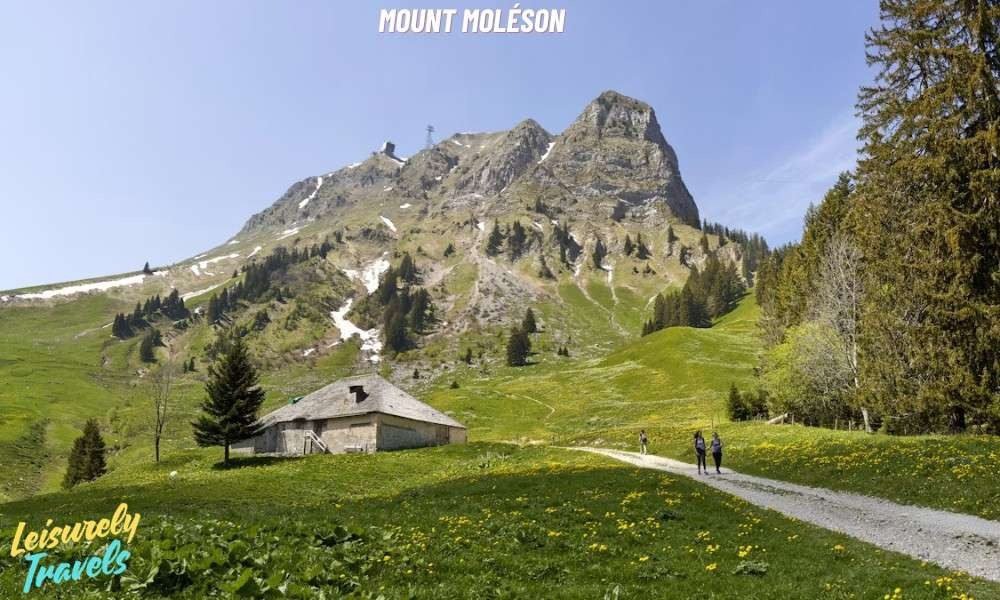
Southwest of the town, Mount Moléson rises as the highest point in the whole municipality, reaching 2,002 meters above sea level. Compared to giants like the Jungfrau, Eiger, and Mönch near Interlaken, that height sounds modest, yet Moléson still stands as the most prominent peak around Gruyères.
On a clear day, the mountain frames a truly beautiful photo of the medieval town, with Gruyères Castle sitting right in front of it. Winter brings skiing and sledding to the slopes, while spring and summer shift things toward hiking, via ferratas, mountain cheese dairies, and an alpine slide for kids.
Getting up starts with a trip to Moléson-sur-Gruyères, reachable by car in ten minutes or bus 263, free with the Swiss Travel Pass. From the medieval town itself, bus 260 connects to the 263 at Gruyères station, adding up to about half an hour total. From there, a funicular runs to Plan-Francey, followed by a cable car up to the summit. Staying at least one night in Gruyères makes it easier to fit the mountain in without rushing.
The alpine coaster ranks among the top reasons to make the trip. A solo ride runs CHF 6, or CHF 22 for a tandem session covering four rides between two people. Careening through the Swiss Alps with the wind picking up and the trees blurring past makes for an honestly unforgettable few minutes.
Worth knowing: visiting during the off or shoulder season, like April, means some attractions may run limited hours. The gondola occasionally closes during quieter stretches, though the mountain coaster and restaurant usually stay open regardless, which honestly covers the two things most visitors come for anyway.
Where to Eat at Moléson
After all that adventuring, Café Restaurant La Pierre à Catillon makes an easy stop to refuel. Attached to a small guesthouse where visitors can also book a room, the menu leans into Swiss comfort food, a local take on Rösti, pasta dishes, and Swiss ice cream served in a frozen bowl.
Down at the base, chickens, sheep, and pigs roam the property near one of the local restaurants, adding a farm-like charm to the stop. Note that Moléson makes the most sense when the mountain and gondola are both fully in season; outside of that window, options thin out to mostly snow sports and the coaster itself.
Day Trip to Bulle
Bulle holds the title of capital of the Gruyère district, and getting there is actually easy. Buses run frequently, and the stops stay simple enough to navigate without much planning.
Here’s the plot twist, though: the whole town tends to shut down for hours right in the middle of the day. Anyone hoping for lunch here should plan on eating early, ideally before noon, since everything from casual sandwich shops to elevated dining closes and doesn’t reopen until 5 or 6 p.m.
A handful of cafés and bakeries do stay open through the gap, offering baked goods and drinks for anyone caught out at the wrong hour. Seats there tend to fill up fast once locals catch on too. Beyond the lunch quirk, Bulle is a really walkable town with plenty of foodie-friendly restaurants worth returning for, especially for anyone with more time to spare on a future visit.
Getting Around the District
Gruyères sits as one of seven districts in the canton of Fribourg, and getting around within it stays simply easy. Inside the village itself, walking covers pretty much everything, since most attractions and restaurants sit close together.
Exploring beyond the medieval town, toward other villages and towns in the wider Gruyère area, works just as smoothly. A main bus station near the train station makes navigating simple, even for anyone unfamiliar with public transport in general. That freedom to hop between villages, without needing a car or a rigid plan, ends up being one of the easiest parts of exploring the whole district.
Where to Eat in Gruyères
Chalet de Gruyères & Auberge de la Halle
Chalet de Gruyères ranks as a popular choice among visitors, known for its homey Alpine atmosphere and generous portions of fondue and raclette. It’s the kind of spot that fits the mood of the town perfectly.
Auberge de la Halle, right in town, comes up often too as a solid local recommendation for anyone looking for a second option. Both work just as well for dinner as they do for lunch, each serving traditional Swiss cuisine built around regional ingredients.
Fromagerie d’alpage de Moléson
Fromagerie d’alpage de Moléson keeps coming up as a solid lunch option, and for good reason. It doubles as a great cheese shop too, making it an easy stop for anyone craving fondue after a morning spent exploring the town’s stranger museums.
Chocolaterie de Gruyères
For anyone not feeling compelled to devote half a day to Maison Cailler, Chocolaterie de Gruyères works as a lovely, low-key alternative. This little locally owned chocolate shop sits right by the bus station at the bottom of the hill.
Despite being tiny compared to Maison Cailler, watching the chocolatiers work here still makes for a genuine treat. Crafting sweet delights right in front of visitors, it’s an easy spot to pop into for something sweet before moving on. Somewhere in the mix, it’s also worth trying the traditional fondue moitié-moitié, a half-and-half blend of two local cheeses that’s become a regional specialty in its own right.
The Swiss Travel Pass & DayPass La Gruyère
The Swiss Travel Pass covers a lot of ground here. A combined ticket for the H.R. Giger Museum and Gruyères Castle normally runs around €19, but pass holders walk in free without paying a thing at either.
The DayPass La Gruyère works a bit differently, built specifically for the region. It covers free public transport on the Frimobil network for a full day, plus free admission to Gruyères Castle, the Maison du Gruyère show dairy, and Maison Cailler.
Staying overnight adds another perk on top: the Be my Guest card from the canton of Fribourg unlocks discounts across a range of local offers, worth checking into for anyone spending more than a day in the area. Full pass details and current pricing are available on the official Swiss Travel Pass site.
Where to Stay in Gruyères
A day trip works well for Gruyères, and plenty of visitors base themselves just over the border in France instead, in towns like Évian-les-Bains, where costs run noticeably lower. Switzerland ranks among the most expensive countries in Europe, and that reputation holds true here too.
For anyone staying overnight, Hotel Fleur de Lys stands out as a seriously charming pick. This quaint boutique hotel carries real medieval flair and sits literally in the center of town, making it an easy base for exploring on foot.
Both the hospitality and the food here run spectacular, with service that feels doting without being overbearing, the kind that makes a stay feel properly cared for. The hotel’s restaurant serves a quintessential Swiss fondue moment too, priced around CHF 30, alongside a salaison plate (salted meats) for CHF 13.50 and pickles for CHF 3.50.
Le Saint George, just a few doors down from Fleur de Lys, is worth considering too, especially for dinner. The hotel restaurant’s covered patio delivers sweeping panoramic views of the Swiss Alps, the kind of view that makes the meal feel like an event on its own.
Locals tend to come out for dinner here as well, and on quieter evenings, deer have been known to wander down the hillside just as the sun sets. Double cream meringues, a specialty of the region, are worth ordering if they’re on the menu.
Looking for more options? Browse hotel options on Booking.com to compare what’s available.
Know Before You Go
Getting around the district of Gruyères rarely costs much. Inexpensive buses cover pretty much anywhere within the area, and much of it works fine on foot too, keeping transportation really budget-friendly.
Credit cards get accepted almost everywhere, especially inside hotels, museums, and restaurants, so carrying much cash isn’t strictly necessary day to day. With prices quoted in Swiss Francs throughout this guide, our currency converter makes it easy to check what everything actually costs before the trip.
Outside of booking accommodation, there’s little else worth stressing over in advance, particularly during the quieter off-season stretch in early spring. Part of the appeal here is exploring without a rigid itinerary and still seeing everything worth seeing. Tipping isn’t mandatory or expected anywhere in Switzerland, though rounding up a bill for truly good service is a nice gesture some travelers choose to make.
If driving, a vignette (the annual Swiss motorway toll sticker, around 40 CHF) is required, picked up easily at gas stations before hitting the road. Travel insurance is also worth arranging ahead of time, given how costly healthcare and unexpected mishaps can get in Switzerland.
Combo tickets scattered around town can shave a fair bit off overall costs, and anyone relying on public transit should double-check evening train times before heading out, since return schedules run less frequently later in the day.
FAQs
By train, connect through Bulle from Geneva, Bern, or Zurich. Driving takes the A12 motorway, with a vignette required for Swiss roads.
Yes. The medieval town, castle, and cheese and chocolate factories make it a strong day trip from most of western Switzerland.
A full day covers the highlights well. Add a second day for Mount Moléson or a trip to Broc.
Yes, though hours shift seasonally. Checking the castle’s official schedule before visiting is worth it.
Its medieval castle, Gruyère cheese, the H.R. Giger Museum, and its fairy-tale old town.
Yes, trains and buses connect Gruyères, Bulle, Broc, and Moléson without issue.
Often yes, since it covers free entry to the castle, Giger Museum, and Cailler chocolate factory.
About two hours by train, or roughly an hour and a half by car.
Final Thoughts
Gruyères earns the fairy-tale comparisons that get thrown at it, cobblestones, a castle on a hill, and cheese and chocolate at every turn. It’s small enough to see in a day, yet layered enough to pull people back for a second visit.
Between the medieval streets, the alien-themed museum tucked into a 400-year-old château, and a mountain coaster waiting just up the road, this town covers more ground than its size suggests. Whether the draw is history, food, or something stranger, Gruyères tends to deliver on all three.

